Welcome to your Digital Sales Kit where you can access tools to educate yourself and your customers on the Cellavision® digital imaging products!
Begin with the Product Overview and work your way through all the links.
Become CellaVision® Certified
The CellaVision® Academy offers training classes to become Certified CellaVision® Applications Specialists and Service Engineers. Each class is made up of several webinar sessions and attendees are expected to attend all sessions.
This training is free of charge to our distribution partners. Read the course descriptions and requirements carefully to know what to expect and what's expected from you.
Demo
EBS White Paper
View the White Paper for the CellaVision®.
Sales Training
Watch the recorded sales training event.
CellaVision® Academy
Get started with CellaVision® Academy Training.
ROI Calculator
Download the CellaVision® ROI Calculator.
Frequently Asked Questions
What is the average time saved with CellaVision® and what is the cost comparison to a Tech?
We typically tell potential CellaVision® customers that the CellaVision® technology will decrease turnaround time by greater than 50% as compared to manual microscopy. Cutting the cost of the differential significantly while dramatically insuring improvement in consistency and quality.
Is there reimbursement for Manual Diffs?
Yes, the CPT code is 85007 is for a Manual Diff only, however, most Diffs are done as a reflex from an automated CBC analyzer and the follow up M-diff cannot be charged. The automated CBC with Manual/Auto Diff code then is 85025. They cannot bill both for the same sample. CV is considered the same as a Manual Diff for most purposes.
Does each user need a license to remotely view slides for the Remote Review Software?
There is only one workstation with the analyzer. CellaVision® Remote Review Software (CRRS) uses another PC on their network to view the same results as the analyzer. To do this they have a few options:
- Single user license key plugged into the PC that they want to use to review results
- Multiuser license SW that is installed on their network that can allow 5, 25 and 75 users depending on their need (and cost)
Is there a STAT option on the DM1200 if you are running a cassette of slides you can interrupt to do a STAT single slide?
You can do STAT interrupt on DM1200 and then restart if necessary.
How many of the DM1200 units are currently placed in the US? Where? What other distributors are we competing against?
Most major hospitals in the US use a larger CV system such as the DM1200. We have hundreds of them in the US. All the CBC companies that come to mind sell CellaVision® with their CBC analyzers (Abbott, Beckman-Coulter, Siemens, Sysmex, Horiba etc.).
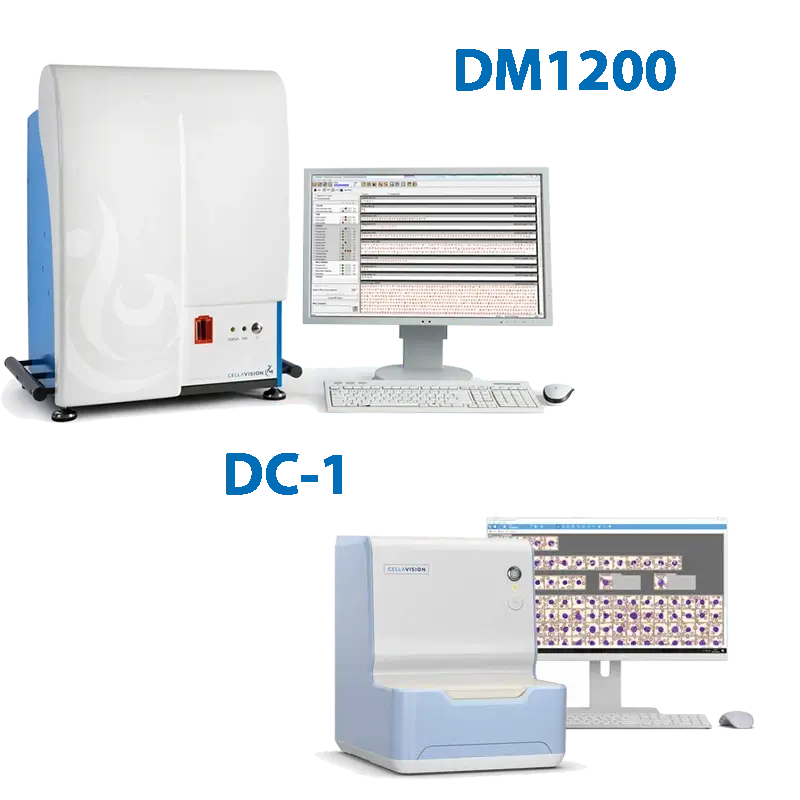
Our niche are the Aerospray® users in smaller labs (DC-1) and larger clinics or small hospitals that use your strainers and would fit the volume for a DM1200.
Since the DC1 is not FDA cleared in US, do we have the ability to sell it now?
We cannot sell DC-1 in the USA until FDA cleared. We do have CE mark and sell in Canada and many LATAM counties. We have placed quite a few successfully.
Is the peripheral application available on both the DC-1 and DM1200, with the advanced RBC application being available on the DM1200 only? What are the major advantages of the Advanced RBC application?
The advanced RBC application pre-classifies and standardizes all the RBC morphology versus only 6 morphology on the regular application.
You can still call the morphology on the regular application, but that is done by the tech.
The camera statement of "high quality camera" is not specific on the type of camera. What type of camera, how many mega-pixels, or is this CMOS? What type of camera is in the boxes?
This is not a spec we use or advertise as it is not relevant. What is important is we use a 100x objective, so we have great cellular detail. After we run the image through our AI system, we color "correct" it so the operator sees something that they expect and are used to.
What other distributors are we competing against?
The only real competitor is the microscope, and the decision to keep the status quo. In our market, you would only have a CBC company that decided to sell one through a sub-distributor. In larger hospitals, you would surely see a bundle from a CBC company.
How is it determined which company (distributors) owns the sale?
For CellaVision® support, directly with a customer, they help the first Distributor that makes a request. They will not go back to that customer with another partner. As far as a competitor, there is no exclusivity, so another distributor could offer CV as well. In this case, it is up to the customer to pick the vendor they would like. (CellaVision® charges a fee for this support.)
How does pay for slide work?
Capital Purchase or Smart Card (PPA) for DC-1. With the smart card option, only available on the DC-1, the customer might get a lower capital cost in exchange for purchasing a set number of cards each month with tests on them from ELITechGroup. The unit can only be used as a pay per analysis (PPA) and only ELITechGroup cards would work on that system after installation. This is an option that can be used at your discretion.
What kind of objective and magnification does this instrument have?
- DM1200: One 10x objective and one 100x objective and intermediate optics switching between 1.0x and 0.5x magnification which combined yields images with 5x, 10x, 50x, or 100x magnification
- DC-1: One 100x objective
What file format are the images and how many MB/GB per slide?
Any image that is sent or copied from the software is in a .jpeg format.
A single cell image is around 30 kB (50 kB for DC-1), and the RBC overview is 1 MB (11 MB for DC-1). All Images from a full Peripheral Blood sample order will be about 5 MB (16 MB for DC-1).
Internal storage of our systems is 20 GB or up to 5000 slides (DM) respectively 1200 slides (DC).
Does this work both for glass coverslip and special tape for slides?
We do not recommend the use of cover-slipped slides on CellaVision® systems as it can interfere with the system's ability to focus.
How can pathologist share results? Review results?
The software has an option to mark orders/slides for "pathology review".
Reviewing of the results resp. the preclassification of the system can be done directly on the system computer or via remote access, which needs a remote review software license.
How does the instrument look for the monolayer? How does it decide which cells to image on the slide and which not?
The system starts to scan the slide at a fix point in the thick area of the smear (33 mm from the edge), moving stepwise to the thinner area of the smear. Based on different factors such as the number of RBC contours, start and end point of the optimal monolayer is determined.
The analyzer will capture the first 100 (or however many ordered) WBCs it finds. The DM1200 and DM9600 uses 10x magnification to locate objects that might be WBCs. Those analyzers always locate 3 times as many potential WBCs as ordered, in case some objects turn out to be artifacts, smudge cells or non-WBCs when captured in 100x magnification.
Are digital slide scanners a direct competition for your products?
Digital slide scanners are no direct competition as they do not automatically locate monolayer area and individual cells and provide a pre-classification of WBC' and a pre-characterization of RBC'.
Do we need special quality slides?
DM1200 and DM9600 require barcode labeled slides with clipped or round corners, and ground edges. DC-1 accepts slides with, clipped, round or square corners, with or without ground edges.
Do we also have an option for bone marrow interpretation?
An application dedicated for bone marrow samples is not available now. However, we have customers using the digital scan option for bone marrow samples as it provides the option to scan, digitalize and view the slide, mark regions of interest (ROI) and export them as well as any comments that the user can add to the slide.
Does the instrument capture and save the entire slide?
No we don't capture images of the entire slide as it is not recommended to count cells for a blood differential in areas other than the optimal monolayer.
Is the remote software included to the DC-1 or does the customer buy it additionally?
Remote review software is an additional cost. You can get a single remote review license or a pack of 5, 25 or 75. Please reference your product guide for more information about what comes with the CellaVision® instruments.
Is it possible for a lab with a CellaVision® instrument to share pictures with an expert from another lab for a second opinion, even if the second lab isn't using a CellaVision® Analyzer or remote viewing software?
Yes, the pathologist could email the WBC images to the consulting expert as JPEG files. Of course if the expert has remote review license they could see everything and re-catigorize. Regardless, the images can be shared by JPEG files easily.
How can the CellaVision® system help the workflow, even if the pathologist is not in the laboratory?
The medical technologist or biologist in the lab can email any cells in question to the pathologist to look at, even if they are off site. If the pathologist has remote review software, they could login and view the cells at home on their laptop using remote review software.
Remember, CellaVision® takes a glass slide and makes it digital and it can be easily shared. Think of radiology, X-Rays used to be pieces of film on a light box read out by a radiologist, now computer system.
What percent of customers are equipped with the optional "Advanced RBC application"?
For the DM1200, the Advanced RBC software standardizes the RBC morphology. In the USA, 70 percent or more of the customers buying now, get Advanced RBC software.
When exactly do customers have a real need for the optional "Advanced RBC application"?
It is used in standardizing schistocytes and tear drop cells in different disease states. It is very valuable to the customer when they standardize the Red Cells. The uses for the Advanced RBC application is very subjective, please see the marketing matierial for published articles about the Advanced RBC application.
What instruments can utilized the optional Advanced RBC application?
The optional Advanced RBC software can be used on the DM1200 and DM-9600.
Can you used the DC-1 without a barcode on the slide?
Yes, you can manually enter the patient ID on the keyboard.